
Code of Conduct
Our Code of Conduct details the school's expectations regarding student behaviour, attire, device use and examinations.
SJCian's Code of Conduct
Every SJCian matters and the school aims to nurture a caring culture and positive climate. Students learn well when there is order and discipline. At the same time, they need care, encouragement and space to learn from mistakes and improve. Discipline is an educative process, and the goal is to instill self-discipline and good character in SJCians, equipping them with the necessary social and emotional skills to behave thoughtfully and be responsible and respectful individuals.
Every SJCian is expected to be an individual with exemplary character and positive attitude towards school and the community. The following Code of Conduct should guide SJCians’ behaviour and actions at all times.
1. Morning Assembly
SJCians who are Singapore Citizens must sing the National Anthem and take the Pledge. SJCians will take the Pledge with their right fist over their heart.
All SJCians should stand at attention and face the flags when the National Anthem is being sung and the National Pledge recited. Please wear your pinafore when singing the National Anthem and taking the Pledge to maintain a respectful appearance.
2. Attendance & Punctuality
Daily attendance during term time is compulsory. The same is expected for CCA and any activity organised by the school.
SJCians should submit to their Form Teacher, upon return to school, a valid Medical Certificate or Letter of Excuse (not more than 10 per year) from parents or guardians. Absence from school without valid reason is considered as truancy.
SJCians should be punctual for school, CCA and other school activities.
SJCians should be physically present in school for morning assembly by 7:30 a.m. to be marked as present.
Students who are repeatedly late will face appropriate consequences.
SJCians are not allowed to leave the school premises before their scheduled dismissal time without permission.
SJCians who need to leave before the scheduled dismissal time should complete the ‘Early Release Form’. Parents or a close relative must give consent for students to be released early.
3. General Behaviour
In school:
SJCians should show kindness and consideration to others at all times, to promote a positive and safe environment for teaching and learning.
SJCians are also expected to be responsible for the safekeeping of their personal belongings and considerate in the use of all school equipment and facilities.
Every SJCian is responsible for the locker assigned to her. The lockers are school property and may be searched by school authorities.
All food and drinks should only be consumed in the canteen. During timetabled snack break, students may eat in the classroom after seeking permission from the teacher. Students should maintain the cleanliness of classrooms by disposing of all litter in covered bins after eating.
SJCians are not allowed to have in their possession any weapons. They are also not allowed to bring any weapon-like item which is used or intended to be used to cause harm to others.
In the classroom:
SJCians should observe the GROW protocol, as every lesson is an opportunity to grow in character and learning:
Table 1. GROW protocol
Classroom Protocol | Examples of Actions a SJCians Should Exhibit | School Value | |
|---|---|---|---|
G | Greet each other |
| Love |
R | Have Readiness |
| Integrity |
O | Be Organized |
| Humility |
Have an Open mind for learning |
| Tenacity | |
W | Create a Welcoming classroom |
| Gratitude & Love |
In public:
SJCians will be good ambassadors of the school and uphold the image of SJC. They should observe rules and regulations within the areas they are patronising or visiting at all times.
SJCians should also show respect for public spaces and the members of the community. They should be conscious of their behaviour and etiquette in public.
4. Attire & Grooming
School Uniform
SJCians are to wear the prescribed uniform within and outside of school. Modification to the uniform is not allowed.
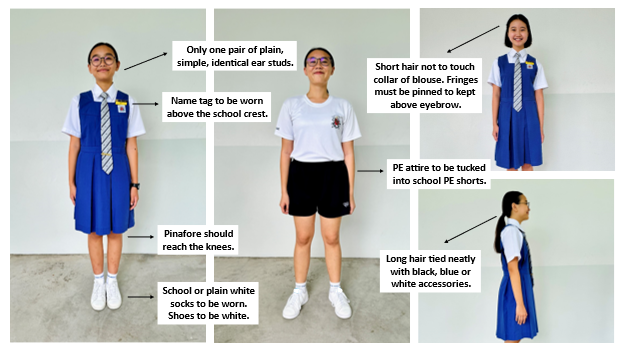
Pinafore must touch the knees and be zipped up at all time.
Only clean, white, low-cut shoes are to be worn. Shoes with fanciful designs (for example, coloured logos and patterns) are not permitted.
Only school socks or plain white socks are allowed. Socks must be worn at an appropriate length, and should not display logos.
Name tags must be worn at all times while in school. Name tags must be fully intact and not have additional embellishments.
Pinafore must be worn upon entering and leaving the school premises.
Physical Education (PE) Attire
On days with Physical Education (PE) lessons, students are allowed to wear the PE T-shirt under their pinafore.
Only the school PE and shorts should be worn for PE lessons.
Students must leave the school premises wearing their pinafores.
On Fridays, students may wear any school-based T-shirt with their pinafore.
Hair
Short hair styles must not touch the collar of the blouse; fringes must be trimmed and kept above the eyebrows at all times.
Very short, shaven or undercut hairstyles are not allowed.
Long hair must be tied neatly with black, blue or white accessories.
Hair accessories and hairstyles must be kept neat, simple and not fanciful.
Hair must not be dyed, tinted, or highlighted.
Hair extensions are not permitted.
Nails
Nails are to be kept short and clean, without nail polish, clear-coloured nail strengthener or any other nail treatment.
Cosmetics and Make-up
Cosmetics (e.g. foundation, sunblock with foundation base, powder, lipstick, tinted lip balm, eyeliner, mascara etc.) are not to be used.
Eyebrows should not be drawn or embroidered.
Eyelashes should remain natural and should not be permed, lifted, or extended.
Coloured or colour-enhancing contact lenses are not allowed.
Handheld or pocket mirrors are not to be used indiscriminately in school.
Jewellery and Accessories
Only one pair of plain, simple, identical ear studs can be worn at the lowest point of the earlobe.
Hoop earrings are not advised for safety reasons during physical activities.
Jewellery and accessories of any other kind (e.g. necklaces, bracelets, bangles, ankle bands, rings, friendship bands, tongue studs, nose ring, lip piercings, smiley piercings, helix stud, etc.) are not allowed.
Others
All forms of body art, including tattoos and henna, are not allowed.
Medical patches (e.g. pimple patches) should be skin-toned and blend naturally.
5. Use of Electronic Devices
Students should use their personal digital devices for appropriate purposes during lessons.
Electronic devices, including mobile phones and any other communication devices should be switched off and kept away in their handphone compartments during school hours and CCA time, unless otherwise instructed by the teacher.
Students are responsible and accountable for the safekeeping of their personal devices.
The school reserves the right to confiscate any electronic device if they are not used responsibly and appropriately. Once confiscated, the school may require the presence of a parent or guardian before the confiscated device is returned to the student.
SJCians should not charge their personal electronic devices in school, including their mobile phones.
Personal Learning Devices (PLDs) (e.g.,Chromebooks): Note-taking can be done on PLDs with DMA installed. Devices without DMAs should not be used. To prevent distractions, these devices should only be used for their intended educational purposes. Students should not attempt to uninstall the DMA or de-enroll the PLD from the DMA. Non-compliance may lead to disciplinary action in accordance with the school’s discipline policy. Your teacher’s permission is required if you need to take photos, videos or audio recordings during lessons.
Ethical Usage of PLDs. Students are to interact with others in the online learning community in a respectful and responsible way. Students should not attempt to access data, system and information that you are not authorised to.
Reading Devices (e.g., Kindles): Reading e-books is allowed in the spirit of sustainability. However, these devices should be kept away in lockers when not in use.
Earbuds and AirPods: Earbuds and AirPods should not be worn once on school premises. For safety reasons, students should not be using earpieces when moving from one venue to another so that they can be aware of their surroundings. Your teacher’s permission is required for you to use the earbuds and airpods during lessons.
Examination Rules
The examination rules apply to all forms of formal assessment, i.e. Weighted Assessments (WA), End-of-Year Examinations (EYE) and Preliminary Examinations. Students should read, understand and comply fully with the examination rules. They are also responsible for checking and noting the dates and times of the various assessments.
You must be properly attired in your school uniform.
If you are wearing outerwear (e.g. jacket, cardigan, windbreaker, sweater) into the examination venue, you must ensure that your outerwear does not have any unauthorised materials or devices. You may be asked to remove outerwear for checks by examination personnel before or during the examinations.
You should be punctual as no additional time for the paper will be allocated for late-comers.
Be seated at your assigned desk at least fifteen minutes before the commencement of the examination. (Applicable to EYE and Preliminary Examination only)
Place your NRIC or other identification documents on your desk for verification during the examination. (Applicable to EYE and Preliminary Examination only)
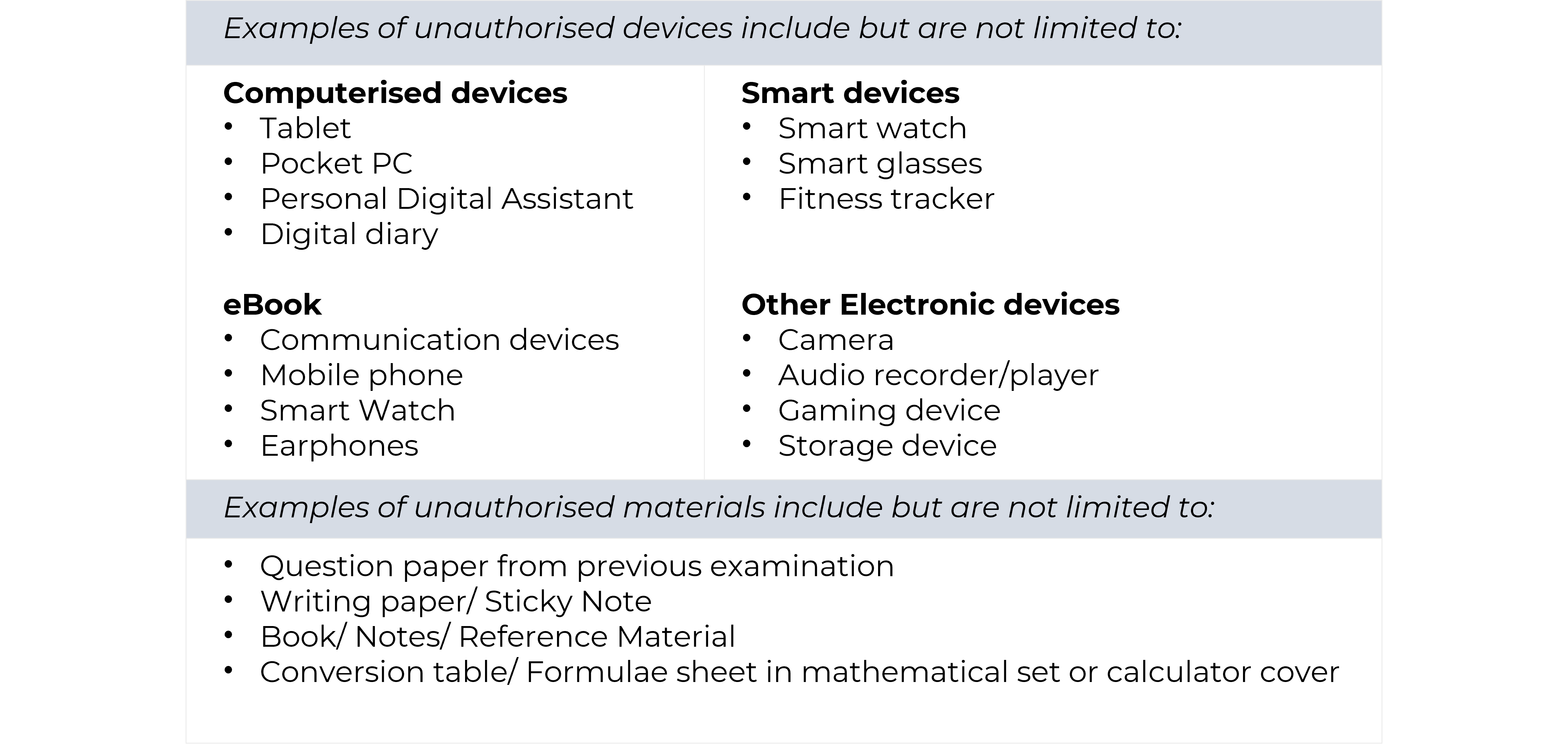
You are not permitted to have in your possession, while in the examination venues, any devices or materials not authorised for use in the examination. If these are found in your possession, you will be deemed as having committed an act of dishonesty and may be awarded a zero mark for the paper.
Smart Watches and Fitness Trackers: In line with SEAB guidelines for tests and examinations, any electronic device capable of scanning, storing, or displaying visual, verbal, or multimedia information—including smart watches with functions like data storage, MP3/MP4 players, cameras, photo galleries, and calculators, as well as fitness trackers—is not allowed.
No form of communication is allowed among candidates in the examination venue.
Food should not be consumed in the examination venue.
Borrowing of stationery during the examination is not allowed.
The use of correction fluid/ tape on your answer script or writing paper is not allowed.
You are not allowed to leave the examination venue unescorted or without permission from the invigilator.
Answer scripts that are removed from the examination venue will not be accepted for grading by the examiners.
Disciplinary action will be taken against any student who breaches the examination rules.
Absence during an examination
If you are unable to sit for any examination due to illness, you must provide a Medical Certificate (MC) to cover your absence. Parent’s letter will not be accepted.
Inform the school or your Form Teacher of your absence. There will be no make-up examination for papers missed.
The MC, issued by a medical practitioner registered under the Medical Registration Act, must be submitted to your Form Teacher upon your return to school.
If you do not have a medical certificate to cover your absence, you may be given a ‘zero’ (0) for the papers missed
Guidelines on Disciplinary Measures
Table 2. Minor Offences Guidelines
Minor Offences | Possible Actions Taken by School |
|---|---|
Attendance and Punctuality
|
Minor offences committed persistently will be considered as a major offence.
|
Attire and Grooming
| |
General Behaviour
|
Table 3. Major Offences Guidelines
Major Offences | Possible Actions Taken by School |
|---|---|
General Behaviour
|
|
Truancy
| |
Dishonesty
| |
Serious Offences
|
Note: The school reserves all rights to add, amend or adjust the school rules and regulations, disciplinary consequences necessary to support character development and maintain a safe and positive learning environment.
Zero Tolerance For Bullying
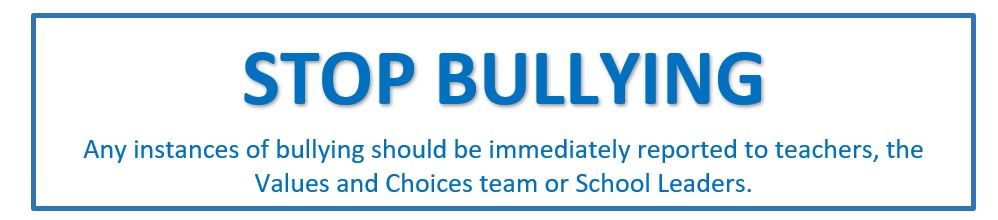
In CHIJ Schools, we uphold the basic principle of respecting the dignity of each person we interact with. Everyone in our school community has the responsibility and a role to play in building a safe learning environment where we treat each other with respect and understanding. As such, our school will not tolerate any unlawful or disruptive behaviour, including any form of bullying, cyber-bullying, intimidation or retaliation.
Different Forms of Bullying
Table 4. Forms of bullying
Types of Bullying | What it could look like |
|---|---|
Physical Bullying |
|
Verbal Bullying |
|
Social Bullying |
|
Cyber Bullying |
|
Incident Reporting Form here. (opens in new tab)